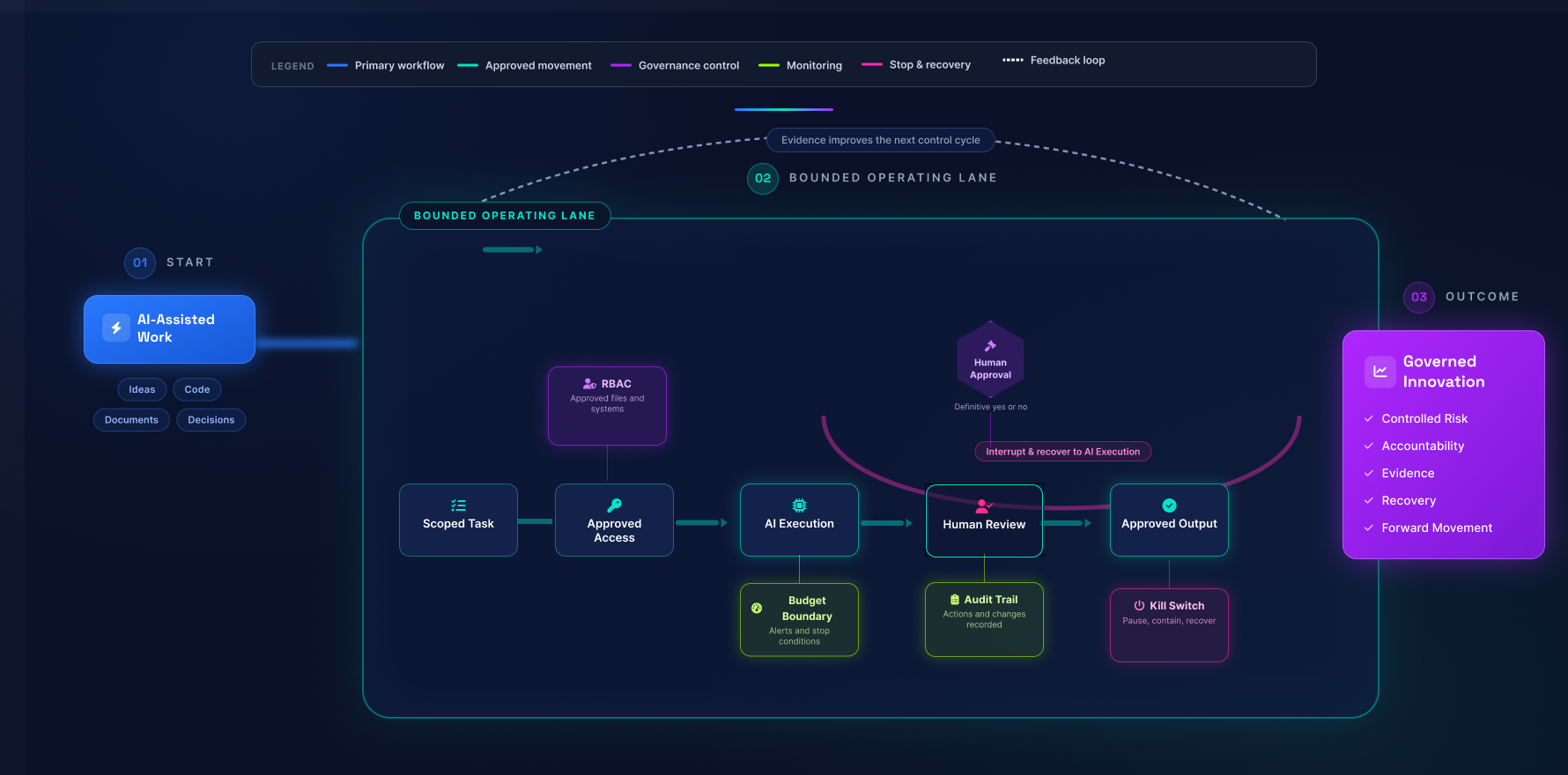
Here is the point I keep coming back to: AI governance for smaller operators should not feel reserved for the biggest labs, the largest vendors, or companies with full security departments. Smaller operators can still put meaningful guardrails in place. We may not have the same resources. But we can still be intentional about access, budgets, documentation, approvals, monitoring, and recovery. The scary stories in the news should not make us feel helpless. They should remind us to build reasonable controls around powerful AI systems.
AI Governance for Smaller Operators Starts With One Practical Guardrail
That is where the conversation gets more useful. AI governance for smaller operators works best when it starts with language people can actually use. As we look for better ways to constrain data and create both prompt-based and bounded guardrails, cybersecurity gives us that language. The idea is not to make AI governance feel more complicated. The idea is to make it more practical, more layered, and more available to the people already using these tools.
Some of these controls already live in the tools we use every day. In my own case, I have been working through practical financial guardrails for AI-assisted development. I will not share the internal design or implementation details. But the lesson is clear: once you build one bounded control around cost and usage, you start to see how the same pattern can apply across other agents in an organization.
What Public Incidents Teach AI Governance for Smaller Operators
The news cycle can make AI risk feel overwhelming, but I do not think helpless is the right takeaway. For me, AI governance for smaller operators has to stay practical. As I read public reporting and company statements around recent AI security and governance incidents, I kept coming back to one question: what can I do inside my own environment to add stronger bounded guardrails around my agents and AI usage?
These episodes were eye-opening. No one company has all the answers. Even mature, well-resourced organizations can run into unexpected gaps, edge cases, or operational questions as AI systems become more capable. That lesson matters. Smaller operators should not wait for perfect vendor controls before they build reasonable governance layers in their own environments.
Lessons I Took From the Public Material
Here are a few governance lessons I took from reading the public material:
- Use layered, independent controls so one safeguard can compensate when another fails.
- Update the threat model as AI systems become more capable, persistent, and autonomous.
- Plan for containment and oversight because multi-step agents can amplify security or alignment failures.
- Do not rely on a single dashboard, prompt rule, or policy; monitoring must be paired with enforceable boundaries.
- Humans must be the definitive yes or no operators
That is the uncomfortable but useful lesson I took from these incidents. Even well-resourced organizations can encounter gaps or unexpected failure modes. That does not let the rest of us off the hook. If anything, it shows why governance cannot only live at the vendor level. Anyone putting AI into real workflows should ask a simple question: what boundaries, reviews, logs, approvals, and stop conditions exist in my own environment?
Why Defense in Depth Matters for AI
As I read through all of this, I kept thinking: how in the world am I supposed to make a difference if even companies with deep technical benches can still run into issues? But the more I sat with it, the more it clicked. Defense in depth is already a normal cybersecurity idea. With AI, it matters even more. We cannot count on one tool, one policy, or one prompt rule to carry the whole load. That is also why ISO 42001 makes sense to me. It is not one magic control. It is a layered set of principles that helps an organization add structure, accountability, oversight, and recovery around AI systems.
This is where smaller operators can actually start. Governance does not have to begin with a massive enterprise use case or a giant framework that stops everything in its tracks. Start with one practical use case. Build governance as you go. That is one of the easiest ways to avoid getting bogged down. The goal is not to let governance get in the way of innovation. The goal is to give innovation enough structure to keep moving without creating avoidable risk.
A Small Use Case Can Teach Practical AI Guardrails
That is why a small use case matters. AI governance for smaller operators becomes much easier to start when the use case is concrete. One practical area I am working through is AI development cost governance. It starts with a simple problem. Agentic tools can move fast. They can consume resources quickly. They can also create cost risk if nobody is watching. That one use case gives me a way to practice layered governance without trying to solve every AI risk at once.
The Controls Do Not Have to Be Fancy
- RBAC: Define who or what can access sensitive files, cost data, and decision points. Not every person, workflow, or agent should have the same level of authority.
- Network segmentation: Keep agents limited to approved systems, repositories, folders, or workflows. The point is to keep the work inside a defined lane instead of letting one tool roam across everything.
- Audit logs: Preserve enough records to understand what happened, what changed, why it changed, and whether the result matched the expectation. Good records help turn lessons learned into better controls.
- Human approval: Require a person to approve higher-risk actions before they move forward, especially when the work affects cost, scope, architecture, controls, or client-facing output.
- Kill switch: Define the point where work pauses because spend, scope, or risk has crossed a boundary. The stop condition can start manually, but the principle is the same: the system needs a way to interrupt itself before risk becomes uncontrolled.
That is what makes this feel doable to me. I am not trying to solve every AI governance problem at once. I am taking one practical use case, putting reasonable boundaries around it, learning from the evidence, and then using that pattern to build the next layer.
Let Evidence Improve Practical AI Governance
Two practical lessons came out of that work pretty quickly. First, test estimates against reality. Early cost assumptions can be wrong, especially when caching, model behavior, or reporting windows are involved. That does not mean the effort failed. It means the governance loop needs room to learn from actual evidence and get better over time.
Second, model choice is also a governance decision. The strongest model is not automatically the right model for every job. For routine, scoped, incremental work, a more cost-appropriate model may be the better control choice. Higher-cost reasoning still has a place. It may make sense for major reviews or complex decisions. But using it everywhere can create avoidable spend risk without adding enough value.
That is the part I think is easy to miss. AI governance for smaller operators does not have to show up as a big heavy process after the innovation is already moving. It can grow alongside the work, one real use case at a time, with each lesson becoming the next control layer.
Applying Defense in Depth to AI Development Workflows
For me, this is not just a theoretical exercise. I use AI-assisted development tools in my own workflow. That makes the governance question very practical. These tools can read context, suggest changes, reason through options, and accelerate feature work. That power is useful. It also means the workflow needs boundaries around cost, scope, approval, and execution.
Layer the Controls Around the Workflow
That is why I treat these tools like agentic systems that need a layered control model, not just a prompt instruction. Budget alerts, stop conditions, scoped instructions, and governance documentation can all play a role. The goal is to catch spend, scope, or risk issues early enough to trigger review.
This also changes how I approve work. I do not give an AI tool open-ended permission to build anything it wants. I use a human-in-the-loop process for higher-risk work. I review smaller pieces based on scope, cost, risk, and alignment with the governance framework. The tool may assist with implementation. The approval authority stays with the human operator.
Keep the Public Lesson, Protect the Playbook
In practice, that means combining several layers without turning the article into an implementation manual. The exact internal design can stay private. The public lesson matters most: do not rely on one safeguard. Build a defense-in-depth control framework around the AI workflow. That makes financial, technical, and governance risks easier to spot before they become uncontrolled.
For CTOs and CFOs using agentic coding tools or similar workflows, this point matters most to me. Do not govern these tools like ordinary software subscriptions. Govern them like systems that can consume resources, accelerate technical change, and create operational risk. That calls for preventive, detective, corrective, and recovery controls. It also calls for human approval at the right decision points.
Documentation Needs Guardrails Too
The same thinking applies to documentation. I am also practicing defense in depth by using Microsoft Purview around my own files and governance materials. If your Office tenant does not have bounded guardrails around documentation, that can become an issue quickly. Purview gives smaller teams a practical control layer. It helps secure file structures, support RBAC, and reduce the chance that sensitive governance materials sit out in the open. It adds depth around chat agents, coding agents, and more advanced agentic workflows.
Closing Thought: AI Governance for Smaller Operators Is Still Governance
That is the point I want to leave people with: practical governance still counts. It does not have to start as a huge platform, a perfect framework, or a fully staffed security program. It can start with one workflow, one risk, one budget boundary, one approval point, or one documentation control. What matters is that the control is real, intentional, and improving over time.
Smaller operators are not powerless here. We may not have the same teams or budgets as the largest companies, but we can still make good decisions about what our agents can access, what they can change, when they need approval, what gets logged, and when the work needs to stop. That is not slowing innovation down. That is giving innovation enough structure to survive contact with the real world.
For me, AI governance is becoming less about having the perfect answer on day one. It is more about building the right habits early. Constrain what matters. Document what happened. Review the places where risk increases. Keep the human operator clearly accountable. That is how smaller teams can move forward without pretending the risk is someone else’s problem.
We do not need to wait for perfect vendor controls before we start. AI governance for smaller operators can begin with reasonable layers now, then improve as evidence comes in. That is how practical guardrails become a real governance system. If you are looking for ways to mitigate risks, Memforma can help.
Start with one real workflow where AI is already being used and add practical boundaries around it. That could mean limiting access, requiring approval, tracking activity, or setting a budget threshold. The point is to begin where the risk is real, not where the framework looks perfect.
Practical guardrails include access limits, scoped workflows, audit records, human approval points, budget thresholds, and stop conditions. They do not have to be fancy to be useful. They just need to be clear, intentional, and tied to how the work actually happens.
Defense in depth means not trusting one safeguard to do all the work. For AI, that can mean combining policy, prompts, access controls, monitoring, approval, documentation, and recovery steps so that one weak point does not become the whole failure path.
Prompt-based guardrails tell the system how it should behave. Bounded controls limit what the system can actually access, spend, change, or execute. Both matter, but bounded controls are stronger because they create real operating limits instead of relying only on instructions.
RBAC helps define who or what has authority. Audit logs preserve evidence of what happened. Human approval keeps important decisions with a person. Kill switches create a stop condition when spend, scope, or risk crosses a boundary. Together, they create a more durable governance layer.
AI development tools can consume resources quickly, change code or content rapidly, and influence operational decisions. That makes them closer to active systems than passive subscriptions. They need review points, scope limits, and cost controls that match the speed and impact of the work.
Microsoft Purview can help classify, protect, and control access to sensitive documentation. For AI work, that matters because governance notes, client materials, internal decisions, and risk records should not be treated like ordinary loose files.
Governance supports innovation when it gives teams enough structure to move safely. Good guardrails make it clearer what is allowed, when review is needed, and where the boundary is. That reduces confusion and helps the work keep moving without creating avoidable risk.
For smaller operators, practical ISO 42001 thinking means building habits around accountability, oversight, risk review, documentation, and continuous improvement. It does not have to begin as a fully mature management system. It can start with small controls that become stronger over time.
One use case gives you a place to test the pattern. You can define the risk, add controls, observe what works, document what changed, and improve the process. Once that loop works in one area, the same control pattern can be adapted to other AI workflows.